
GPU Tier List 2026
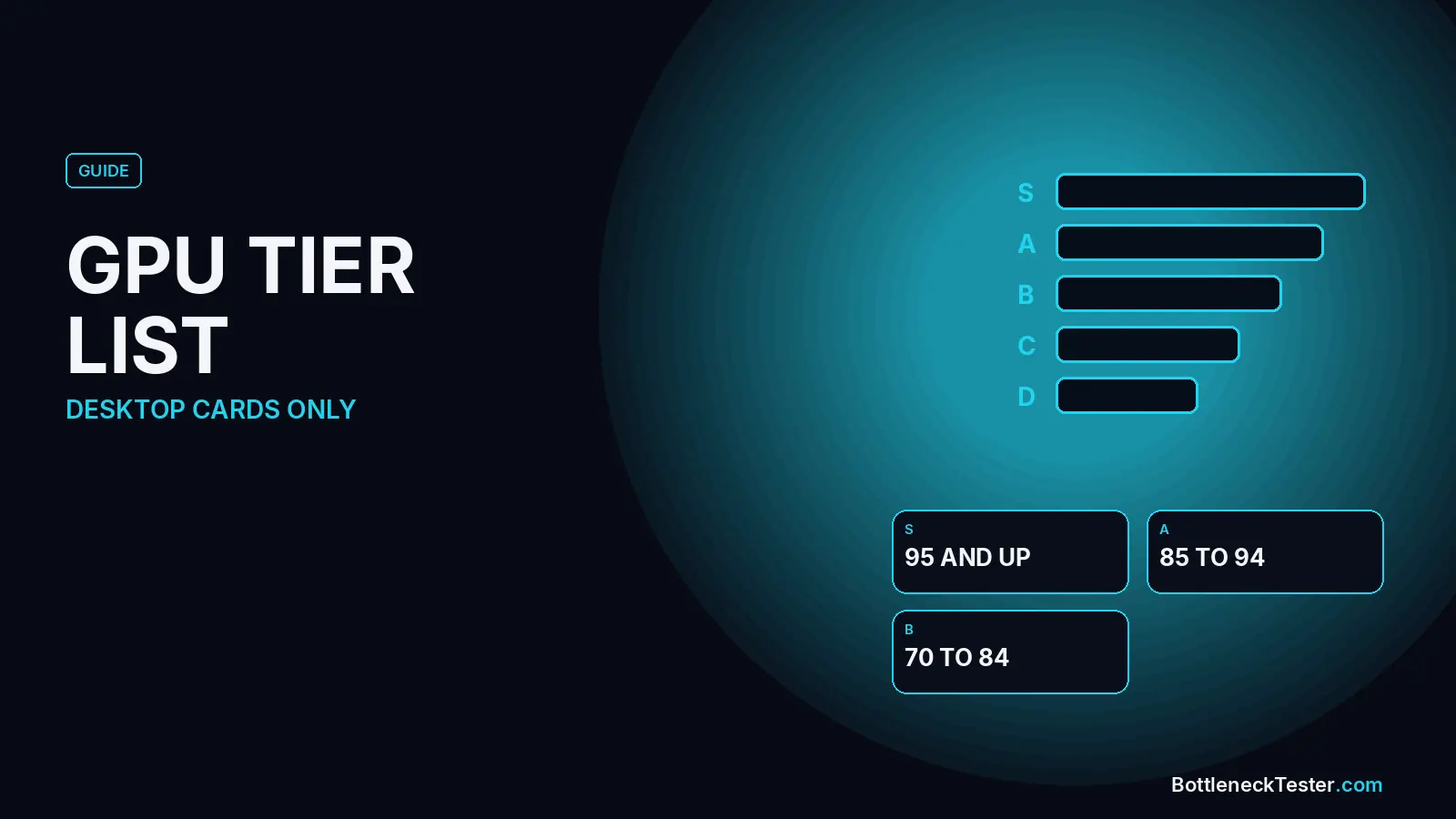
This GPU tier list ranks current and recent desktop graphics cards by the gaming score in our hardware database, the same scores that power our bottleneck calculator. It adds one thing other tier lists don’t: for every card, the slowest common gaming CPU that can keep up with it at 1440p. That tells you not just which card is fastest, but what processor you need to get its full performance.
Quick Answer: Best GPUs Right Now
- Fastest overall: RTX 5090 (score 100), followed by the RTX 4090 (99) and RTX 5080 (97).
- Best high-end value: RX 9070 XT (89) and RTX 5070 Ti (88). Both have 16GB of VRAM and only need a Ryzen 5 5600-class CPU at 1440p.
- Best for 1440p: RTX 5070 (84), RX 9070 (87) and RX 7800 XT (80).
- Best budget cards: RTX 5060 Ti 16GB (76), RX 9060 XT 16GB (74) and Arc B580 (66), all easy to pair with an older six-core CPU.
How the Tiers Work
Each card’s tier comes from its gaming score out of 100: S is 95 and above, A is 85–94, B is 70–84, C is 55–69, and D is below 55. Scores are relative: a card at 50 is roughly half as fast in games as the RTX 5090 at 100. Laptop GPUs, workstation cards (Quadro, RTX A-series) and integrated graphics are left out, because they aren’t what you buy for a gaming desktop.
The CPU column: we run each card through our calculator at 1440p with a list of popular gaming CPUs, from the Ryzen 5 3600 up to the Ryzen 7 7800X3D, and show the slowest one that keeps the CPU limit under 10%. Any faster CPU works too. At 1080p you need a bit more CPU; at 4K, a bit less.
S Tier: The Fastest Graphics Cards
3 cards score 95 or higher. These are built for 4K and high refresh rate 1440p, and they need a strong platform and power supply. Even here, a Ryzen 5 5600-class CPU stays just under 10% at 1440p, but for 1080p or high refresh rates our pairing guides recommend much faster chips: see the best CPU for an RTX 4090 and the best CPU for an RTX 5080.
| GPU | Gaming score | VRAM | Power (TDP) | Slowest common CPU under 10% at 1440p |
|---|---|---|---|---|
| RTX 5090 | 100 | 32 GB | 575 W | Ryzen 5 5600X (9.2%) |
| RTX 4090 | 99 | 24 GB | 450 W | Core i5-11400F (9.7%) |
| RTX 5080 | 97 | 16 GB | 360 W | Ryzen 5 5600 (9.7%) |
A Tier: High-End 1440p and 4K
10 cards score 85–94. This is the value end of high-end gaming: the RX 9070 XT, RTX 5070 Ti and RX 9070 deliver most of the S-tier experience at 1440p, with 16GB of VRAM, and a Ryzen 5 5600 already keeps them under 7%.
| GPU | Gaming score | VRAM | Power (TDP) | Slowest common CPU under 10% at 1440p |
|---|---|---|---|---|
| RTX 4080 SUPER | 92 | 16 GB | 320 W | Ryzen 5 5600 (7.6%) |
| RX 7900 XTX | 91 | 24 GB | 355 W | Ryzen 5 5600 (7.1%) |
| RX 9070 XT | 89 | 16 GB | 304 W | Ryzen 5 5600 (6.3%) |
| RTX 4080 | 89 | 16 GB | 300 W | Ryzen 5 5600 (6.3%) |
| RTX 5070 Ti | 88 | 16 GB | 300 W | Ryzen 5 5600 (5.9%) |
| RX 7900 XT | 87 | 20 GB | 315 W | Ryzen 5 5600 (5.5%) |
| RX 9070 | 87 | 16 GB | 220 W | Ryzen 5 5600 (5.5%) |
| RTX 4070 Ti SUPER | 87 | 16 GB | 285 W | Ryzen 5 5600 (5.5%) |
| RTX 3090 Ti | 86 | 24 GB | 450 W | Ryzen 5 5600 (5%) |
| RTX 4070 Ti | 85 | 12 GB | 300 W | Core i5-10400F (9.7%) |
B Tier: Mainstream 1440p
18 cards score 70–84, from the RTX 5070 at the top to the RX 6700 XT. This is the tier for 1440p at high settings, and every card here is easy to feed: even a Ryzen 5 3600 stays under 10%. When buying new, prefer 12GB or 16GB models, such as the RTX 5060 Ti 16GB over 8GB cards.
| GPU | Gaming score | VRAM | Power (TDP) | Slowest common CPU under 10% at 1440p |
|---|---|---|---|---|
| RTX 5070 | 84 | 12 GB | 250 W | Ryzen 5 3600 (9.7%) |
| RX 7900 GRE | 83 | 16 GB | 300 W | Ryzen 5 3600 (9.2%) |
| RTX 3090 | 83 | 24 GB | 350 W | Ryzen 5 3600 (9.2%) |
| RTX 3080 Ti | 82 | 12 GB | 300 W | Ryzen 5 3600 (8.8%) |
| RTX 4070 SUPER | 82 | 12 GB | 220 W | Ryzen 5 3600 (8.8%) |
| RX 6950 XT | 81 | 16 GB | 300 W | Ryzen 5 3600 (8.4%) |
| RX 9070 GRE | 81 | 12 GB | 260 W | Ryzen 5 3600 (8.4%) |
| RX 6900 XT | 80 | 16 GB | 300 W | Ryzen 5 3600 (8%) |
| RX 7800 XT | 80 | 16 GB | 263 W | Ryzen 5 3600 (8%) |
| RX 6800 XT | 79 | 16 GB | 300 W | Ryzen 5 3600 (7.6%) |
| RTX 3080 | 79 | 10 GB | 320 W | Ryzen 5 3600 (7.6%) |
| RTX 4070 | 78 | 12 GB | 200 W | Ryzen 5 3600 (7.1%) |
| RX 7700 XT | 76 | 12 GB | 245 W | Ryzen 5 3600 (6.3%) |
| RTX 5060 Ti | 76 | 16 GB | 180 W | Ryzen 5 3600 (6.3%) |
| RX 6800 | 75 | 16 GB | 220 W | Ryzen 5 3600 (5.9%) |
| RX 9060 XT | 74 | 16 GB | 182 W | Ryzen 5 3600 (5.5%) |
| RX 6700 XT | 70 | 12 GB | 230 W | Ryzen 5 3600 (3.8%) |
| RTX 3070 Ti | 70 | 8 GB | 300 W | Ryzen 5 3600 (3.8%) |
C Tier: 1080p Gaming
22 cards score 55–69. They handle 1080p well and 1440p at reduced settings. Watch the VRAM column: several popular cards here, such as the RTX 4060, RTX 5060 and RTX 3070, have 8GB, which is becoming a limit in new games. Our VRAM bottleneck guide explains why.
| GPU | Gaming score | VRAM | Power (TDP) | Slowest common CPU under 10% at 1440p |
|---|---|---|---|---|
| RX 6750 XT | 69 | 12 GB | 220 W | Ryzen 5 3600 (3.4%) |
| RTX 3070 | 69 | 8 GB | 220 W | Ryzen 5 3600 (3.4%) |
| RTX 4060 Ti | 68 | 8 GB | 160 W | Ryzen 5 3600 (2.9%) |
| RTX 5060 | 67 | 8 GB | 145 W | Ryzen 5 3600 (2.5%) |
| RX 7600 XT | 66 | 16 GB | 220 W | Ryzen 5 3600 (2.1%) |
| Arc B580 | 66 | 12 GB | 190 W | Ryzen 5 3600 (2.1%) |
| RTX 2080 Ti | 66 | 11 GB | 300 W | Ryzen 5 3600 (2.1%) |
| RTX 3060 Ti | 62 | 8 GB | 200 W | Ryzen 5 3600 (0.4%) |
| RX 6700 | 61 | 10 GB | 220 W | Ryzen 5 3600 (0%) |
| RTX 2080 SUPER | 61 | 8 GB | 220 W | Ryzen 5 3600 (0%) |
| RTX 2080 | 60 | 8 GB | 220 W | Ryzen 5 3600 (0.6%) |
| RTX 4060 | 60 | 8 GB | 115 W | Ryzen 5 3600 (0.6%) |
| RX 7600 | 59 | 8 GB | 165 W | Ryzen 5 3600 (1.2%) |
| Arc A750 | 59 | 8 GB | 225 W | Ryzen 5 3600 (1.2%) |
| Arc A770 | 59 | 16 GB | 225 W | Ryzen 5 3600 (1.2%) |
| RTX 2070 SUPER | 59 | 8 GB | 220 W | Ryzen 5 3600 (1.2%) |
| RX 5700 XT | 58 | 8 GB | 225 W | Ryzen 5 3600 (1.7%) |
| RTX 3060 | 58 | 12 GB | 170 W | Ryzen 5 3600 (1.7%) |
| Arc B570 | 57 | 10 GB | 150 W | Ryzen 5 3600 (2.3%) |
| VII | 56 | 10 GB | 220 W | Ryzen 5 3600 (2.9%) |
| RTX 2070 | 56 | 8 GB | 220 W | Ryzen 5 3600 (2.9%) |
| RX 6650 XT | 55 | 8 GB | 220 W | Ryzen 5 3600 (3.5%) |
D Tier: Older and Entry-Level Cards
Below 55 are older and entry-level cards. These are the popular ones people still own. Many are still fine for esports titles and older games at 1080p, but they are the first upgrade to make in most systems, since almost any modern CPU outpaces them.
| GPU | Gaming score | VRAM | Power (TDP) | Slowest common CPU under 10% at 1440p |
|---|---|---|---|---|
| RX 6600 XT | 54 | 8 GB | 160 W | Ryzen 5 3600 (4.1%) |
| GTX 1080 Ti | 53 | 11 GB | 220 W | Ryzen 5 3600 (4.6%) |
| RX 5700 | 52 | 2 GB | 45 W | Ryzen 5 3600 (5.2%) |
| Arc A580 | 52 | 8 GB | 220 W | Ryzen 5 3600 (5.2%) |
| RTX 2060 SUPER | 52 | 8 GB | 220 W | Ryzen 5 3600 (5.2%) |
| RX 5600 XT | 46 | 2 GB | 45 W | Ryzen 5 3600 (8.7%) |
| RX 6600 | 46 | 8 GB | 132 W | Ryzen 5 3600 (8.7%) |
| RX 9060 | 44 | 8 GB | 150 W | Ryzen 5 3600 (9.9%) |
| RTX 2060 | 44 | 6 GB | 140 W | Ryzen 5 3600 (9.9%) |
| GTX 1080 | 42 | 10 GB | 220 W | Ryzen 5 3600 (11%) |
| RTX 3050 | 41 | 8 GB | 130 W | Ryzen 5 3600 (11.6%) |
| GTX 1070 Ti | 40 | 6 GB | 140 W | Ryzen 5 3600 (12.2%) |
| GTX 1660 SUPER | 37 | 6 GB | 125 W | Ryzen 5 3600 (13.9%) |
| GTX 1660 Ti | 37 | 6 GB | 140 W | Ryzen 5 3600 (13.9%) |
Which GPU Should You Buy?
- Upgrading from a D or C tier card: moving up one full tier is the change you’ll clearly feel. A move within the same tier is often not worth the cost.
- For 1080p: C tier or low B tier. Spend extra on VRAM (12–16GB) rather than raw speed.
- For 1440p: B tier, or A tier for 144Hz+ monitors.
- For 4K: A tier at minimum, S tier for high settings with ray tracing.
- Check your CPU and PSU first: use the CPU column above, then confirm your power supply can handle the card’s power draw with our PSU guide.
For pairing details, see the RTX 4060, RTX 4070, RTX 5070 and RX 9070 XT CPU guides, or compare any two cards in the GPU compare tool.
Methodology
Gaming scores, VRAM and power figures come from our hardware database, which is calibrated against published GPU hierarchy benchmarks. The CPU column comes from our bottleneck calculator at 1440p with 16GB DDR4-3200 dual-channel memory, an NVMe SSD, a 144Hz target, and ray tracing and upscaling off. Treat scores as relative gaming performance, not exact FPS, and run your own parts through the bottleneck calculator for a specific build.
Frequently Asked Questions
What is the best GPU right now?
The RTX 5090 is the fastest in our data. For value, the RX 9070 XT and RTX 5070 Ti offer A-tier performance with 16GB of VRAM.
Why is the RTX 5070 in B tier and not A?
Its gaming score is 84, one point below the A-tier line at 85. It sits at the very top of B tier and plays very similarly to the low end of A tier.
What CPU do I need for an A-tier GPU?
At 1440p, a Ryzen 5 5600-class CPU keeps every A-tier card under 10% in our calculator. For 1080p or 144Hz and above, choose a faster chip such as a Ryzen 7 7800X3D.
Is a higher tier always worth the money?
No. Tiers are based on performance, not price. Two cards in the same tier perform similarly even when their prices differ, so within a tier, buy the cheaper one with enough VRAM.
Related guides
GPU Compare: Compare Any Two Graphics Cards
Compare gaming score, VRAM, TDP, and a 1440p bottleneck estimate for current graphics cards, with the CPU held still so the card is the only change.
CPU Compare: Compare Any Two Processors
Compare cores, socket, gaming score, and a 1440p bottleneck estimate for eight CPU pairs, with an RTX 4070 held still so the chip is the only change.

Thermal Throttling: When Heat Becomes Your Bottleneck
Normal GPU temp is about 65-85°C in games; the real limit is your card's rated maximum. Safe CPU and GPU temps, hotspot vs core, and how to fix throttling.